


CGénial Foundation: 7 Years of Role-Based Governance with No Turning Back
“Clarity and organizational agility allow everyone to fully utilize their skills and reach their full potential. It gives people wings. And every organization needs that.”
In Brief
Organization: CGénial Foundation
Sector: Education, Science & Technology, School-Business Partnerships
Platform: Talkspirit | Structure, Meetings, and Goals modules in use since 2020
Team: 25 employees · 196 roles · 50+ partners coordinated nationwide
Key Strength: 7 years of role-based governance with no turning back: clarity, agility, and autonomy in support of the educational mission
The Context
The CGénial Foundation’s mission is to foster young people’s interest in science and technology by strengthening ties between schools and businesses and developing project-based learning. In practice, this means simultaneously managing about ten national programs— from CGénial Competition to company visits for teachers — while coordinating some fifty partners, including government ministries, school districts, and a network of regional stakeholders.
In 2018, the team consisted of six people. Hélène Chahine, the Executive Director, sensed that the ongoing growth would require a more robust organizational framework. But not just any framework.
With 15 years of experience at a Dutch company characterized by direct, co-management, Hélène was looking for a system that respected people and was focused on efficiency. It was upon discovering Frédéric Laloux’s *Reinventing Organizations* that she began to see an alternative to hierarchical management. Then she came across Holacracy, and, after an initial trial with another platform, she discovered Holaspirit by Talkspirit.
What also appealed to Hélène about this approach was its pragmatism: opting for a proven system rather than reinventing the wheel.
“ What appealed to me about role-based governance was also the fact that it was an off-the-shelf model. Others had already thought through organizational models based on self-management. I wasn’t going to reinvent the wheel. ” Hélène Chahine, Executive Director at Fondation CGénial, Holacracy Leader at the Foundation
THE DEPLOYMENT
Hélène didn’t force the change. She organized a trial day with role-playing exercises, made sure that at least 50% of the team was on board, and then proposed a simple framework: a six-month trial period with the option to revert to the previous system.
THE DEPLOYMENT METHOD
Team testing day, validation of a 50% volunteer base, a 6-month trial period with a return clause. The result: the team never left the trial phase. Seven years later, role-based governance is part of the Foundation’s DNA.
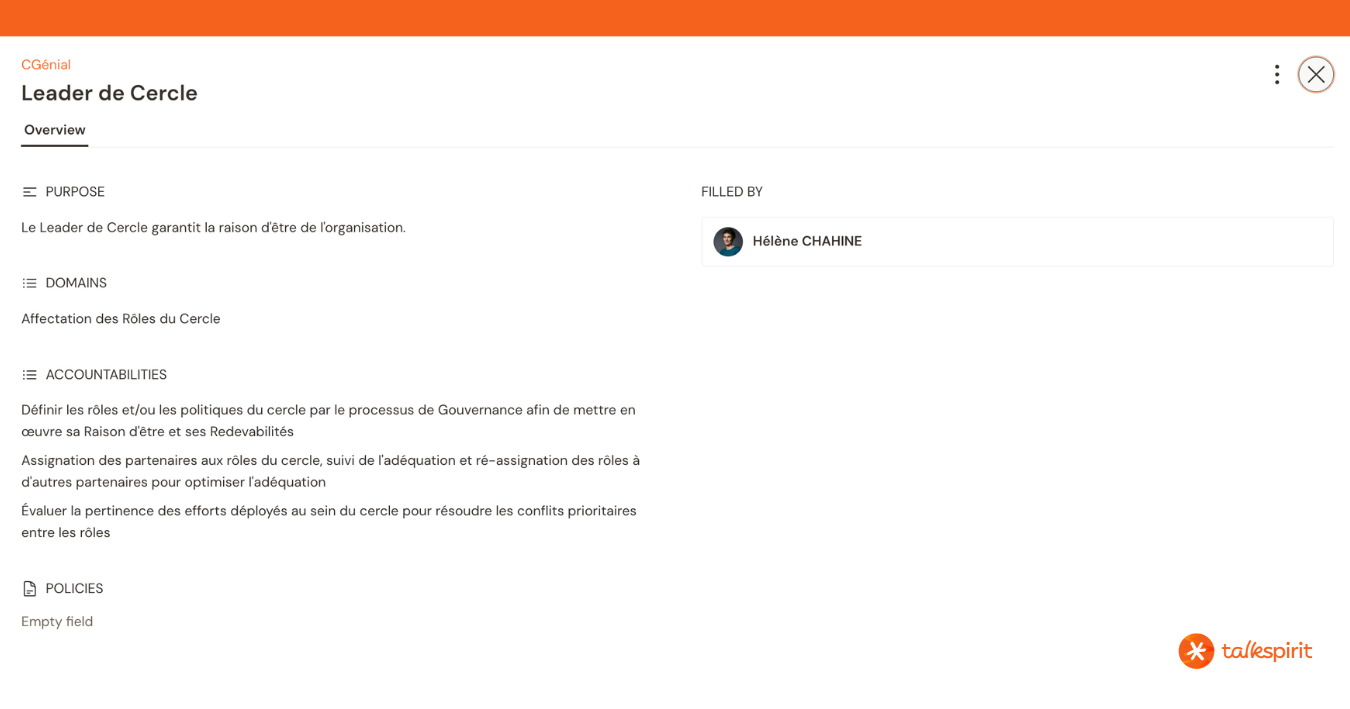
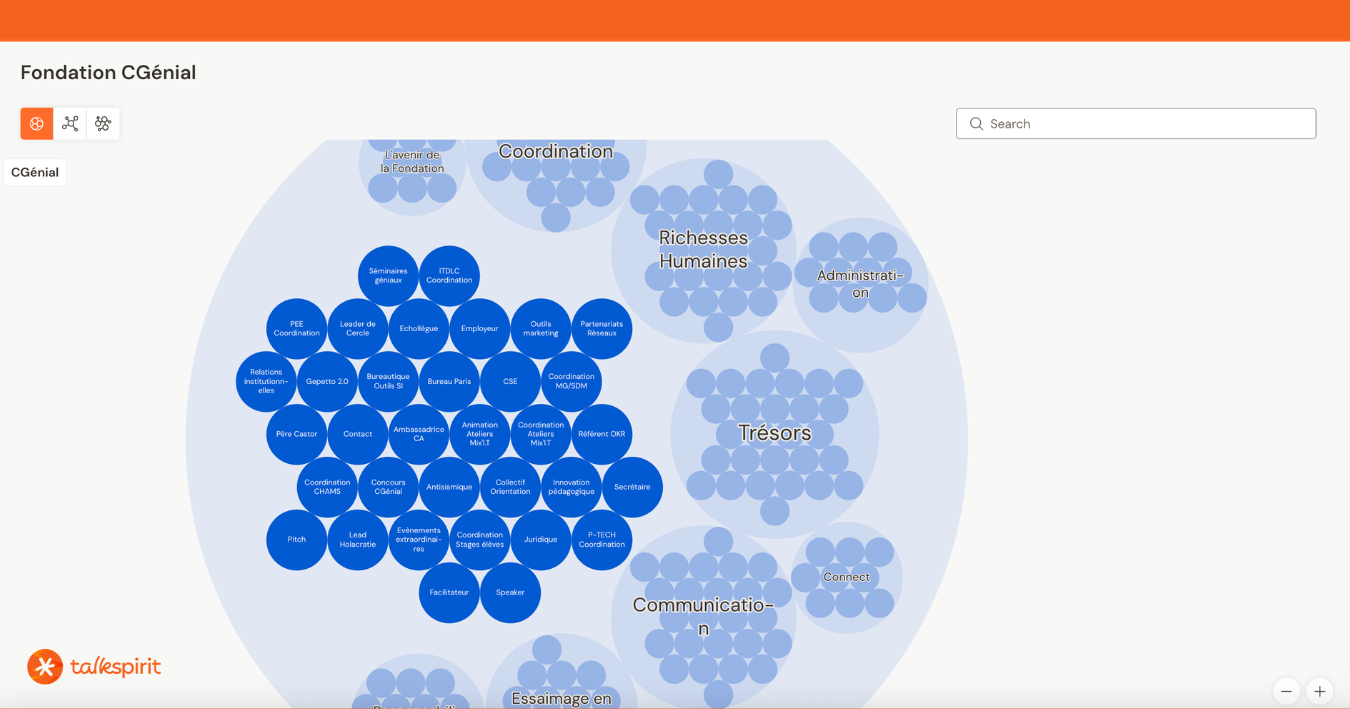
The first concrete step on the platform was to “map out” the existing organization and translate its structure into specific roles. Subsequently, the governance processes built into the platform enabled this structure to evolve organically, in response to the actual needs identified by the team.
EVERYDAY USE
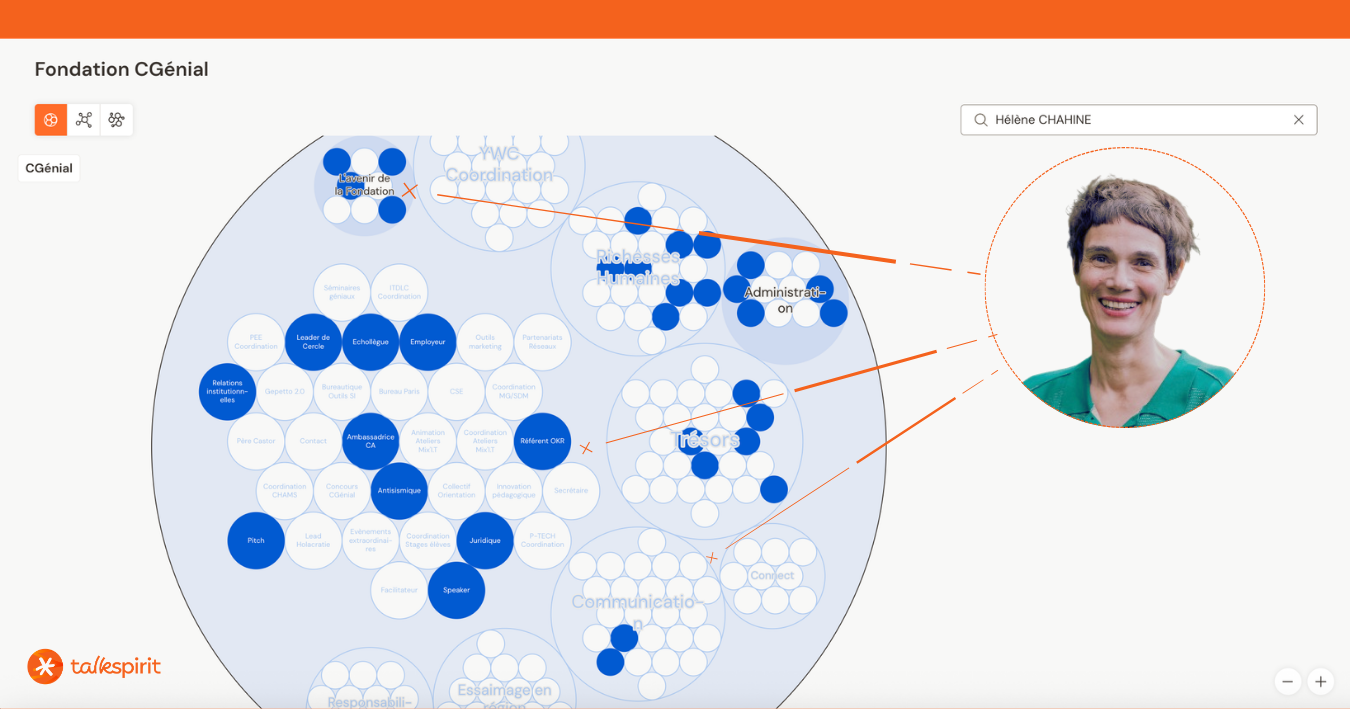
Search: Find out who does what with just one click
With 25 employees and 35 roles just for Hélène, the complexity is real. The platform’s search function solves a problem familiar to every organization: finding the right person—the “who does what.”
“ I don’t need to go through the circle leader to find out who does what. In a traditional organization, you’d talk to the team leader. In Talkspirit, it’s direct. ” Hélène Chahine, General Delegate at Fondation CGénial, Holacracy Foundation Leader
Triage meetings: concrete actions, not forgotten minutes
The team consistently uses the platform’s meeting features: on-the-fly agenda setting, tracking of key metrics, addressing issues one by one with a facilitator, and real-time recording of actions and projects. The result: by the end of the meeting, everything is clear and documented. At the next meeting, everyone reviews the progress of their actions and projects.
“ It saves a tremendous amount of time. By the end of the meeting, you’ve taken action—it’s concrete. Next, you check to see if you’ve completed your tasks. It’s wonderful. The tool holds you accountable. And since you do it in real time, you haven’t wasted any time. ” Hélène Chahine, General Delegate at Fondation CGénial, Holacracy Leader at the Foundation
The team also uses the platform to manage its objectives, which helps align strategic vision, execution, and a shared sense of purpose.
THE RESULTS
Seven years of role-based governance with no turning back
25 employees managed with clarity and autonomy
50 partners coordinated at the national level
Hélène identifies four structural benefits provided by role-based governance powered by Talkspirit:
1. Clarity and transparency
Every team member knows exactly who does what, and what their scope of action and decision-making authority is. And when tension arises, we can rely on our holarchy to resolve it—proof that clarity is the foundation of everything else. The Foundation’s governance structure is also publicly disclosed: some job candidates review the organizational chart online before even applying.
2. Organizational agility
In a traditional hierarchical structure, reorganizing teams is a major undertaking. With Talkspirit, the organization evolves organically and steadily, in step with actual needs. All employees can help shape the organization (by modifying or creating a role, for example) based on the needs they identify while performing their duties.
Asynchronous governance is also a popular feature, allowing proposals to be addressed as they come in without having to involve the entire team.
3. Employees who reach their full potential
The main benefit of role-based organization is the autonomy it gives employees. Another advantage is the opportunity for everyone to take on roles that go well beyond their original job descriptions. At the CGénial Foundation, people without HR training conduct recruitment interviews because they are interested in doing so. Others combine roles in completely different areas, which also allows them to interact with other people in the organization.
“The staff members who conduct the interviews love to talk about how their roles are completely different from their core jobs. You can see them smile when they talk about it. It’s a great opportunity for professional growth.” Hélène Chahine, Executive Director at Fondation CGénial, Holacracy Foundation Leader
4. Impact on the employer brand
Role-based governance has become a key factor in attracting talent to the CGénial Foundation. Job applicants often mention the role-based structure as one of the reasons for applying. Some have even reviewed the public governance structure before applying, asking specific questions about roles they found online.
This also simplifies the onboarding process for new employees: a new employee can immediately see who does what, understand the organization’s purpose, and see where they fit into the bigger picture.
SHARED PURPOSE AND ORGANIZATIONAL PERFORMANCE
For Hélène, there is no basis for pitting shared meaning against performance.
“We have a purpose, we have a direction, we have goals. We’re incredibly performance-driven. Everyone goes all out in their roles to achieve those goals. There’s no conflict. It all goes hand in hand.” Hélène Chahine, Executive Director at Fondation CGénial, Holacracy Foundation Leader
And when an organization gives everyone the space to contribute fully, something remarkable happens: employees take the initiative, drive change, and the leader is no longer the bottleneck.
“This is the first time in the history of management that anyone in the organization can propose a change and have it approved. I’ve already had my objection dismissed because it wasn’t valid. Naturally, I wasn’t very happy about it, but it was for the good of the organization. ” Hélène Chahine, General Delegate at Fondation CGénial, Holacracy Leader at the Foundation
A FEW FINAL WORDS
“Organizational clarity and agility allow everyone to fully utilize their skills and reach their full potential. It empowers people. And every organization needs that.” Hélène Chahine, Executive Director at Fondation CGénial, Holacracy Leader
Ready to help your organization soar?
Discover how Talkspirit can bring clarity and improved performance to your teams.
Book an organizational clarity assessment here.
.png)
Unlock your organization's potential
.
We're here to answer all your questions and support you in your projects.




.jpg)

.jpg)
.png)
.jpg)

%20(1).jpg)

.jpg)


%2520(1)%2520(1).jpeg)
%2520(3)%2520(1).jpeg)


